Learn How to Read Market Structure
Learn How to Read Market Structure: A Beginner’s Guide Understanding market structure is one of the most important skills every trader should learn. Whether you trade stocks, forex, commodities, o...
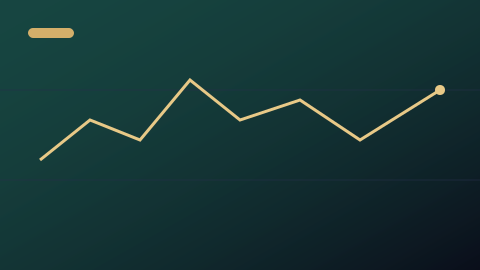
<p><strong>Learn How to Read Market Structure: A Beginner’s Guide</strong></p><p>Understanding <strong>market structure</strong> is one of the most important skills every trader should learn. Whether you trade stocks, forex, commodities, or cryptocurrencies, knowing how the market moves can help you make better decisions with greater confidence.</p><p>Many beginners jump into trading by relying only on indicators or tips, but experienced traders know that price action tells the real story. This is where market structure becomes valuable.</p><p>Market structure helps traders understand whether the market is moving upward, downward, or simply consolidating. Once you understand how to read it, identifying trends, managing risk, and timing trades becomes much easier.</p><p>In this beginner-friendly guide, we’ll break down what market structure means, its different types, how to identify it on charts, and why mastering it can significantly improve your trading journey.</p><p><strong>What is Market Structure?</strong></p><p>Market structure refers to the overall movement and behavior of price on a chart over time.</p><p>Simply put, it helps traders understand whether the market is:</p><ul><li>Moving upward (<strong>bullish trend</strong>)</li><li>Moving downward (<strong>bearish trend</strong>)</li><li>Moving sideways (<strong>range-bound market</strong>)</li></ul><p>It reflects the ongoing battle between buyers (<strong>bulls</strong>) and sellers (<strong>bears</strong>), showing who currently has control of the market.</p><p>You can think of market structure as the <strong>foundation of price action</strong>. It gives traders a clearer picture of where the market has been, where it currently stands, and where it may potentially move next.</p><p>Understanding this structure allows traders to make informed decisions rather than reacting emotionally to random price fluctuations.</p><p><strong>The Three Main Types of Market Structure</strong></p><p><strong>1. Uptrend (Bullish Market Structure)</strong></p><p>An uptrend occurs when price continuously forms:</p><ul><li><strong>Higher Highs (HH)</strong></li><li><strong>Higher Lows (HL)</strong></li></ul><p>This signals that buyers are in control and are willing to purchase assets at increasingly higher prices.</p><p><strong>Example:</strong></p><p>Imagine a stock moves:</p><ul><li>From <strong>₹100 to ₹110</strong> → Higher High</li><li>Pulls back to <strong>₹105</strong> → Higher Low</li><li>Rises again to <strong>₹115</strong> → Another Higher High</li></ul><p>This pattern reflects bullish momentum and suggests market strength.</p><p>As long as price continues making higher highs and higher lows, the uptrend generally remains intact.</p><p>During bullish market structures, many traders look for buying opportunities rather than selling.</p><p><strong>2. Downtrend (Bearish Market Structure)</strong></p><p>A downtrend is the opposite of an uptrend.</p><p>In this structure, price forms:</p><ul><li><strong>Lower Highs (LH)</strong></li><li><strong>Lower Lows (LL)</strong></li></ul><p>This suggests sellers are dominating the market and pushing prices downward over time.</p><p><strong>Example:</strong></p><p>Imagine price behaves like this:</p><ul><li>Falls from <strong>₹100 to ₹90</strong> → Lower Low</li><li>Rises to <strong>₹95</strong> → Lower High</li><li>Falls again to <strong>₹85</strong> → Another Lower Low</li></ul><p>This pattern indicates market weakness and bearish momentum.</p><p>In downtrends, traders often focus on selling opportunities or short-selling setups.</p><p><strong>3. Sideways or Range-Bound Market</strong></p><p>Not every market trends clearly.</p><p>Sometimes, price moves within a fixed range without creating strong higher highs or lower lows.</p><p>This is called a <strong>sideways market</strong> or <strong>consolidation phase</strong>.</p><p>In these situations:</p><ul><li>Price repeatedly bounces between support and resistance levels</li><li>Buyers and sellers remain balanced</li><li>No clear market direction exists</li></ul><p><strong>Example:</strong></p><p>A stock repeatedly moves between <strong>₹100 and ₹110</strong> without breaking out.</p><p>This indicates indecision in the market.</p><p>Although range-bound markets may seem slow, they often lead to strong breakouts or breakdowns once momentum builds.</p><p><strong>How to Read Market Structure on a Chart</strong></p><p>The good news is that reading market structure doesn’t require complicated indicators.</p><p>You can begin with a clean chart and focus on price movement.</p><p><strong>1. Identify Swing Highs and Swing Lows</strong></p><p>Start by locating the market’s turning points.</p><ul><li>Peaks represent <strong>swing highs</strong></li><li>Valleys represent <strong>swing lows</strong></li></ul><p>These points reveal how price behaves over time.</p><p><strong>2. Observe the Sequence</strong></p><p>Ask yourself:</p><ul><li>Are highs getting higher?</li><li>Are lows getting higher?</li><li>Are highs getting lower?</li><li>Is price moving sideways?</li></ul><p>This sequence helps determine the current market trend.</p><p><strong>3. Use Trendlines for Better Clarity</strong></p><p>Drawing trendlines can help visualize market direction more clearly.</p><p>Connecting multiple highs or lows often reveals trend strength and market behavior.</p><p><strong>4. Focus on Higher Timeframes</strong></p><p>For beginners, higher timeframes such as:</p><ul><li><strong>1-Hour Chart</strong></li><li><strong>4-Hour Chart</strong></li><li><strong>Daily Chart</strong></li></ul><p>usually provide a clearer and less noisy market structure compared to shorter timeframes.</p><p>Higher timeframes often help traders avoid confusion caused by short-term market fluctuations.</p><p><strong>Why Understanding Market Structure is Important</strong></p><p>Learning market structure offers several major advantages for traders.</p><p><strong>1. Helps Identify Market Direction</strong></p><p>Market structure reveals whether the market is trending or consolidating.</p><p>This helps traders align their positions with the broader market movement instead of trading blindly.</p><p><strong>2. Improves Trade Entries and Exits</strong></p><p>Understanding price behavior allows traders to enter positions with better timing and avoid chasing trades emotionally.</p><p>It also improves exit decisions by identifying potential reversal areas.</p><p><strong>3. Reduces Trading Risk</strong></p><p>One of the biggest mistakes beginners make is trading against the trend.</p><p>Market structure helps traders stay aligned with momentum and avoid unnecessary losses.</p><p><strong>4. Builds Trading Confidence</strong></p><p>Instead of reacting emotionally to every market move, traders can make logical decisions based on clear price behavior.</p><p>Confidence grows when decisions are backed by structure rather than emotions.</p><p><strong>Common Mistakes Beginners Should Avoid</strong></p><p><strong>1. Ignoring Higher Timeframes</strong></p><p>A trend on a 15-minute chart may look strong but could actually move against a larger daily trend.</p><p>Always zoom out to understand the bigger picture before making decisions.</p><p><strong>2. Forcing Market Structure</strong></p><p>Not every market move forms a clear trend.</p><p>Sometimes traders try to identify patterns where none exist.</p><p>Patience is essential — wait for clear market structure to develop.</p><p><strong>3. Overdependence on Indicators</strong></p><p>Indicators can be useful, but they often lag behind price.</p><p>Market structure focuses directly on price action, making it one of the most reliable ways to understand the market.</p><p><strong>Final Thoughts</strong></p><p>Learning how to read market structure can completely transform the way you approach trading.</p><p>It helps traders understand price movement more clearly, identify market direction, improve trade timing, and make more disciplined decisions.</p><p>Start simple:</p><ul><li>Identify highs and lows</li><li>Understand trend direction</li><li>Keep your charts clean</li><li>Practice consistently</li></ul><p>Over time, reading market structure will begin to feel natural — almost like the market is telling you its story.</p><p>At Trading Tatva, we believe strong trading foundations create long-term success. The better you understand market structure, the more confidently and consistently you can navigate the markets.</p><p>Remember — trading success comes from patience, discipline, and continuous learning.</p><p><strong>Happy Learning!</strong></p>